 Glossary for the KAEPS system
|
Many linguistics terms in this site are cited from
Ladefoged (1993).
Contents:
[affricate]
[allophone]
[alveolar]
[alveolar ridge]
[back vowel]
[fricative]
[front vowel]
[glottal]
[glottis]
[homorganic]
[interlanguage]
[L1]
[L2]
[lax]
[obstruent]
[phoneme]
[stop]
[tap]
[tense]
Affricate
Allophone
A variant of a phoneme. The allophones of
a phoneme form a set of sounds that (1) do not change the meaning
of a word, (2) are all very similar to one another, and (3) occur
in phonetic contexts different from one another -- for example,
in English, aspirated [ ]
in "top" and unaspirated [p] in "stop" are allophones of the
voiceless bilabial stop /p/. The differences among allophones can
be stated in terms of phonological rules.
]
in "top" and unaspirated [p] in "stop" are allophones of the
voiceless bilabial stop /p/. The differences among allophones can
be stated in terms of phonological rules.
Alveolar
An articulatin involving the tip or blade of the tongue and the
alveolar ridge, as in English [d] in "die."
Alveolar ridge
the part of the upper surface of the mouth immediately behind
the front teeth.
Back Vowels
Vowels in which the body of the tongue is in the back part of the
oral cavity (mouth). The vowels [u, o,
 ,
,
 ] form a set of back reference
vowels.
] form a set of back reference
vowels.
Fricative
Narrowing of the distance between two articulators so that the
airstream is partially obstructed and a turbulent airflow is
produced, as in English [a] in 'zoo'
Front vowels
Vowels in which the body of the tongue is in the front part of the
oral cavity (mouth). The vowels [i, e,
 , a] form a set of front
reference vowels.
, a] form a set of front
reference vowels.
Glottal
An articulation involving the glottis, as
[ ] in many forms of English
'button' [
] in many forms of English
'button' [ b
b n].
n].
Glottis
The space between the vocal cords.
Homorganic
Made with the same place of articulatin. The sound [d] and [n],
as in English 'hand,' are homorganic.
Interlanguage
Selinker (1969, 1972)
proposed and elaborated the term interlanguage (IL) to
explain the unique utterances of L2 learners. It is regarded as
a separate linguistic system which
results from a learner's attempts to produce a target language (TL)
norm. Corder
(1971) calls ILs a group of idiosyncratic dialects or even
transitional dialects due to the unstable nature of such dialects.
The following figure (Beebe,
1980:166) shows that the relation of the IL to the native
language (NL) and the target language (TL):
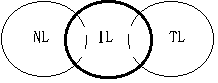
Figure 1: Corder's notion of idiosyncratic dialect or IL in
relation to the NL and the TL
In this figure, the NL and TL may not seem to have common features,
but they do. There must be something the two languages have in
common as human languages. H-K Kim
(1997b) suggests the following diagram:
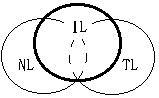
Figure 2: H-K Kim's notion of IL in relation to the NL and
the TL
The more similar the two languages are to
each other, the greater area the intersection part will occupy.
L1
First language. Native language (NL). Mother tongue.
L2
Second language or Foreign language. Target language (TL).
Lax
A term with no specific phonetic correlates, used when dividing
vowels into classes on phonological grounds. In English, the lax
vowels are those that can occur in monosyllables closed by
[ ] such as 'sing, length,
hang, long, hung.'
] such as 'sing, length,
hang, long, hung.'
Obstruent
A fricative, stop, or affricate.
Phoneme
One of a set of abstract units that can be used for writing a
language down in a systematic and unambiguous way. See also
allophone.
Stop
Complete closure of two articulators. This term usually implies an
oral stop - that is, complete closure of two articulators and a
velic closure, as in English [b] in 'buy'. But nasals, as
in English [m] in 'my,' can also be considered stops.
Tap
A rapid movement of the tip of the tongue upwards to
contact the roof of the mouth, then returning to the floor of the
mouth along the same path.
Tense
A term with no specific phonetic correlates, used when dividing
vowels into classes on phonological grounds. In English, the
tense vowels are those that can occur in stressed open syllables
such as 'bee, bay, bah, saw, low, boo, buy, bough, boy, cue.'
[last updated March 8, 2002]
Hyouk-Keun Kim
